Why Odisha’s Stainless Steel Edge Matters Now ?
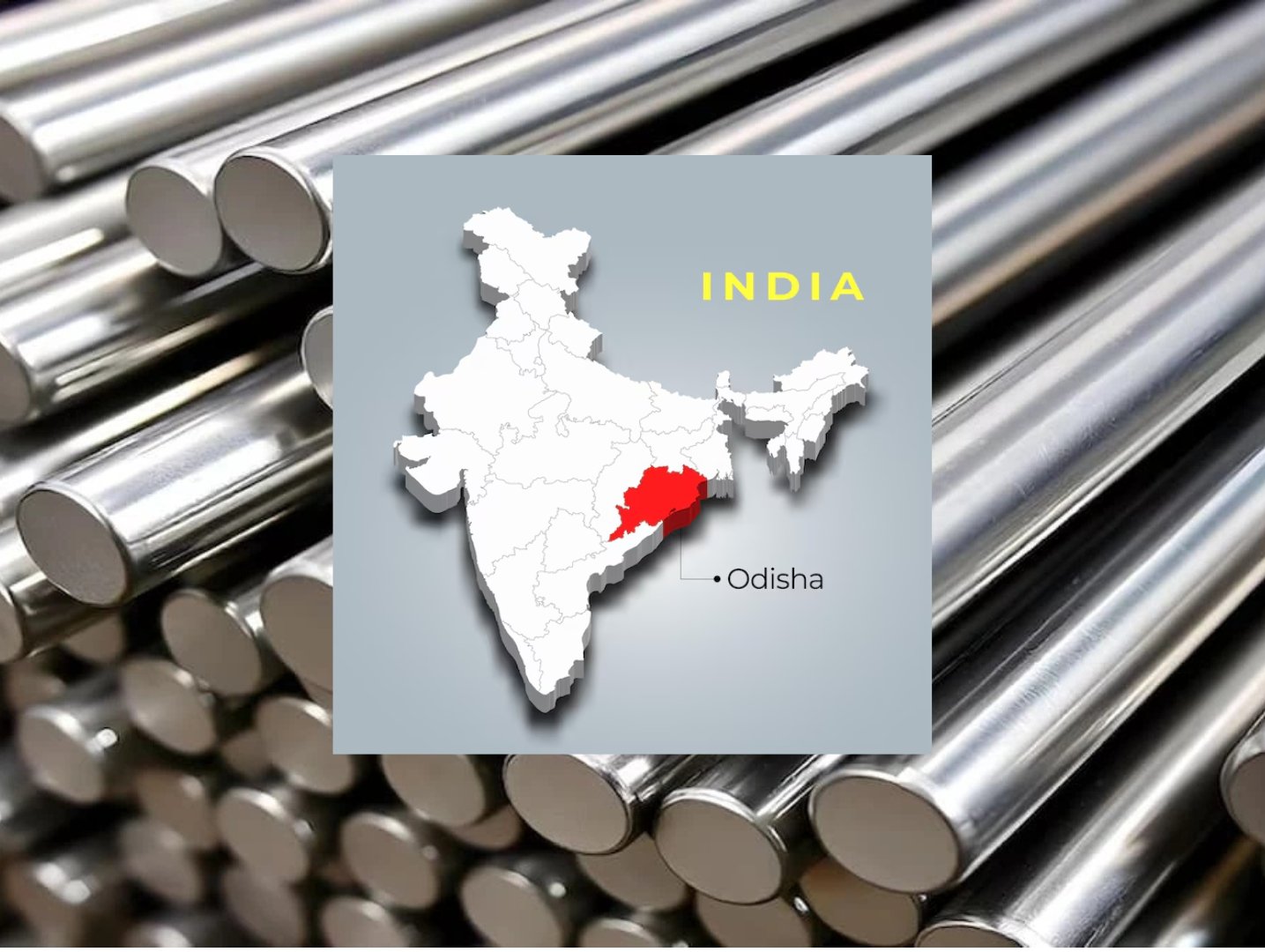
Odisha, a state long known for its mineral wealth, is setting its sights on a bigger role in India’s economic story. Backed by vast iron ore reserves and a strong steel and stainless steel industry, the state now hopes to raise its share of the national GDP from 3 per cent to 5 per cent, guided by a long-term vision for growth, infrastructure, and jobs.
A state rich in steel strength
What does it take for a state to reshape its economic future? For Odisha, the answer may well lie beneath its soil. The state holds nearly one-third of India’s total iron ore reserves, a statistic that not only defines its industrial identity but also shapes its ambitions.
Iron ore is the backbone of steel, and steel remains one of the most critical materials for modern economies. From bridges and railways to automobiles and appliances, steel supports nearly every sector. Odisha’s dominance in this space is striking. In 2024 to 25, the state contributed more than 61 per cent of India’s total iron ore production, underlining its central role in the country’s resource supply chain.
This mineral advantage has translated into industrial leadership. Odisha today holds the first position in the production of steel and stainless steel in India, making it a key driver of the nation’s manufacturing ecosystem. Stainless steel, valued for its strength, durability and resistance to corrosion, has become particularly important for sectors such as infrastructure, healthcare, energy, and food processing.
Industry observers often point out that Odisha’s rise in steel and stainless steel is no accident. The combination of natural resources, policy focus, and growing investment has gradually positioned the state as a heavyweight in India’s metals sector.
The vision for 2036 and beyond
Odisha’s economic ambitions are now framed within a long term roadmap. The state government has prepared a comprehensive vision document that looks ahead to two symbolic milestones: 2036, when Odisha completes 100 years as a state, and 2047, marking 100 years of India’s independence.
According to the state’s leadership, these timelines are not merely ceremonial. They represent targets for economic transformation. The vision aims to turn Odisha into a 500 billion dollar economy by 2036 and a 1.5 trillion dollar economy by 2047.
Central to this plan is a significant shift in Odisha’s contribution to the national economy. The goal is to increase the state’s share of India’s GDP from the current 3 per cent to 5 per cent over the coming decades. Officials argue that this growth will be supported by structural reforms, stronger project execution, and deeper adoption of technology.
The state’s growth projections are equally ambitious. Annual economic growth, currently estimated at around 7 per cent, is expected to rise to 9.5 per cent. Policymakers often describe this as a realistic but challenging target, requiring sustained momentum across sectors.
Economic planners also emphasise that the vision is not confined to headline numbers. It speaks to broader social and developmental goals, including higher per capita income, improved living standards, and reductions in poverty.
Stainless Steel at the core of industrial growth
Odisha’s industrial narrative cannot be separated from steel and increasingly stainless steel. The state is home to 55 steel plants with a combined annual production capacity of around 45 million tonnes, accounting for nearly 23 per cent of India’s total steel output.
This scale gives Odisha a unique position in India’s manufacturing landscape. Steel plants form the backbone of entire industrial clusters, supporting downstream industries, logistics networks, and employment generation.
Stainless steel, in particular, is gaining strategic importance. Its applications span construction, transport, defence, medical equipment, kitchenware, and renewable energy systems. As India pushes for modern infrastructure and advanced manufacturing, demand for stainless steel continues to grow.
Industry experts frequently note that stainless steel is more than just a material. It is an enabler of long-lasting, efficient, and sustainable systems. Its resistance to rust and wear makes it ideal for coastal infrastructure, chemical processing units, and public utilities, areas highly relevant to Odisha.
State authorities have also signalled plans to scale up steel production capacity, with discussions around supplying as much as 100 million tonnes of steel by 2030. Such expansion would further strengthen Odisha’s standing as a steel and stainless steel hub.
Recent industrial activity reflects this momentum. In 2025, the state grounded and inaugurated 85 industrial projects involving investments exceeding 2 lakh crore rupees. These projects, officials say, have created employment opportunities for more than 1.65 lakh people.
Investment outreach efforts have also been vigorous. From investor summits to roadshows across major cities, Odisha has reportedly attracted investment intentions worth over 7.1 lakh crore rupees. Analysts view this as a sign of growing confidence in the state’s industrial prospects, particularly in metals, materials, and advanced manufacturing.
Building roads, rings and connections
No industrial story can progress without infrastructure, and Odisha’s development plans place heavy emphasis on connectivity. Policymakers repeatedly stress that infrastructure is not just about concrete and steel, but about enabling economic activity and improving daily life.
Several large projects have recently received approval. One of the most notable is the 8,300 crore rupees Rameshwar Paradip coastal highway, designed to improve coastal connectivity and reduce travel distance and time by nearly 45 per cent. Such a corridor is expected to benefit trade, tourism, and logistics.
Another major initiative is the six-lane, access-controlled greenfield capital region ring road, often described as the Bhubaneswar bypass, with an investment of around 8,308 crore rupees. This project aims to decongest Bhubaneswar, Cuttack, and Khurda, while also lowering logistics costs and supporting smoother freight movement.
Infrastructure planners frequently highlight that efficient transport networks are essential for heavy industries like steel and stainless steel. Moving raw materials and finished products requires reliable roads, ports, and rail links. Improved connectivity can directly influence competitiveness and investment decisions.
Beyond transport, the state is also investing in technology-driven sectors. The approval of two semiconductor manufacturing units under the India Semiconductor Mission, involving investments of more than 2,066 crore rupees, is being viewed as a milestone. While semiconductors and steel may appear unrelated, officials argue that both are pillars of modern industrial economies.
Debate, dissent and democratic voices
Even as Odisha’s leadership projects optimism, the political landscape remains lively. During the Governor’s address at the start of the Budget session, legislators from opposition parties staged a walkout, questioning the gap between vision and reality.
Opposition leaders argued that the speech painted an overly positive picture, claiming that many citizens, including farmers, young people, and marginalised communities, continue to face challenges. Such criticism is not unusual in democratic settings, where development claims are often debated.
Government representatives, on the other hand, maintain that long term transformation inevitably takes time. They point to investment flows, industrial expansion, and infrastructure approvals as evidence of progress.
Observers often suggest that these exchanges reflect a broader tension familiar across many regions: the balance between ambitious projections and ground-level outcomes. While visions inspire, delivery remains the ultimate test.
Security, stability and growth
Another dimension of Odisha’s narrative involves internal security. State authorities have reported progress in anti-Naxal operations, citing instances of Maoists being neutralised, arrested, or surrendering over recent years.
Officials frequently stress that peace and stability are critical for sustained development. Industrial investments, particularly in sectors like steel and stainless steel, depend heavily on predictable and secure operating environments.
While security developments rarely dominate economic discussions, their influence is widely acknowledged. Stable conditions can accelerate infrastructure work, attract investors, and support job creation.
The road forward
Odisha’s journey illustrates the evolving identity of resource rich states in modern India. Rather than relying solely on extraction, the focus is shifting towards value addition, manufacturing, and technology integration.
Steel and stainless steel stand at the centre of this transformation. With abundant iron ore reserves and significant production capacity, Odisha has both the raw materials and industrial base to pursue its ambitions.
Yet, the path ahead is complex. Economic growth targets, infrastructure execution, social development, and political consensus all play defining roles. Success will depend not just on policy declarations but on consistent, measurable progress.
For now, Odisha’s story remains one of aspiration backed by tangible industrial strength. Whether it can raise its share of national GDP and emerge as a leading growth engine will unfold over the coming decades, shaped by steel, stainless steel, and the choices made along the way.