Subodh Gupta: Transforming Stainless Steel into a Global Artistic Language
When Stainless Steel Becomes Art
Stainless steel is typically associated with durability, hygiene, and utility. It forms the backbone of kitchens, food processing facilities, healthcare infrastructure, and countless industrial applications. Yet Indian contemporary artist Subodh Gupta has redefined how the world views this material by transforming ordinary stainless steel utensils, milk cans, and tiffin boxes into monumental sculptures that explore identity, migration, globalization, and cultural memory. His work matters because it elevates one of India’s most familiar industrial materials into a medium of global artistic expression, proving that stainless steel can carry emotional and cultural significance far beyond its practical use.
From Bihar’s Kitchens to International Galleries
Born in 1964 in Khagaul, Bihar, Subodh Gupta grew up surrounded by the stainless steel utensils that would later become the defining element of his artistic career. Raised in a railway family, he witnessed firsthand how everyday objects shaped domestic life across India. What most people saw as common household items, Gupta eventually recognized as powerful symbols of aspiration, tradition, and social transformation.
A pivotal moment arrived in 1998 when sunlight reflected off kitchen utensils in his home, inspiring him to experiment with arranging them into sculptural forms. That simple observation laid the foundation for a body of work that would later capture international attention.
Stainless Steel as a Storytelling Material
Unlike traditional sculptors who work with stone, bronze, or marble, Gupta chose stainless steel because it was deeply connected to everyday Indian life. The material represented more than functionality; it embodied family rituals, economic mobility, migration, and collective memory.
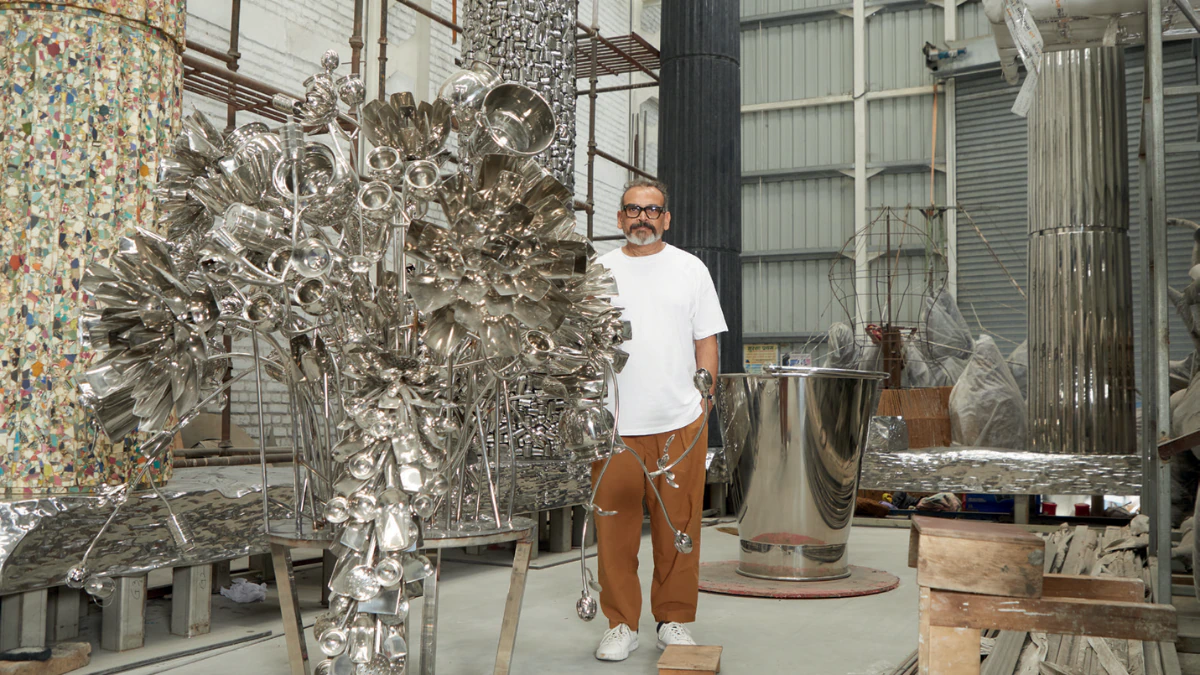
His sculptures often combine hundreds or even thousands of utensils, bowls, plates, buckets, and milk cans into large-scale installations. These reflective surfaces create a visual dialogue between the artwork and its audience, allowing viewers to see themselves within the piece. In doing so, Gupta transforms ordinary objects into mirrors of society itself.
Monumental Works that Captured Global Attention
Several of Gupta’s stainless steel installations have become landmarks in contemporary art.
One of his most recognized works, Very Hungry God (2006), is a giant skull constructed from stainless steel kitchen utensils. The sculpture examines themes of consumerism, mortality, and globalization while demonstrating the extraordinary versatility of stainless steel as an artistic medium. The work helped establish Gupta as one of the world’s most influential contemporary artists.
Another iconic installation, Line of Control (2008), resembles a massive mushroom cloud assembled entirely from stainless steel kitchenware. The sculpture uses familiar household objects to comment on conflict, borders, and geopolitical tensions, illustrating how industrial materials can become vehicles for social commentary.
Through works such as these, Gupta transformed stainless steel from a utilitarian material into a medium capable of conveying complex global narratives.
The Connection Between Stainless Steel and Modern India
Gupta’s artistic success parallels India’s economic transformation over the past three decades. Stainless steel utensils are found in millions of Indian homes, cutting across regional, cultural, and economic boundaries. By incorporating these objects into his work, Gupta captures the story of a nation balancing tradition with modernization.
His installations reflect the movement of people from villages to cities, the rise of consumer culture, and the changing aspirations of a growing middle class. The stainless steel vessels in his sculptures serve as symbols of both continuity and change, linking India’s past with its future.
Industry Perspective: Beyond Manufacturing and Utility
For the stainless steel industry, Gupta’s work offers an important lesson about material value. Stainless steel is widely celebrated for its corrosion resistance, strength, recyclability, and longevity. However, Gupta demonstrates that the material also possesses aesthetic and cultural dimensions.
His sculptures showcase stainless steel’s reflective properties, structural strength, and ability to retain visual appeal over time. In many ways, his installations serve as large-scale demonstrations of the material’s versatility. While manufacturers focus on performance and durability, Gupta highlights its capacity for storytelling, creativity, and emotional engagement.
This intersection of industry and art reinforces stainless steel’s position as one of the most adaptable materials of the modern era.
Redefining the Value of Everyday Objects
A defining aspect of Gupta’s practice is his ability to challenge perceptions of value. Objects that are often overlooked in daily life become extraordinary when assembled into monumental forms. Through stainless steel utensils and milk cans, he invites audiences to reconsider the significance of ordinary materials and the stories embedded within them.
His work demonstrates that innovation does not always require new materials. Sometimes, it emerges from seeing familiar materials differently.
Conclusion
Subodh Gupta has achieved something few artists accomplish: he has transformed stainless steel from a symbol of utility into a symbol of cultural identity and global artistic expression. By turning everyday utensils and milk cans into internationally celebrated sculptures, he has expanded the conversation around what stainless steel can represent.
In an age where materials are often judged solely by their function, Gupta’s work reminds us that stainless steel is more than an industrial product. It is a material capable of preserving memories, reflecting society, and inspiring creativity on a monumental scale. Through his vision, stainless steel has become not only a cornerstone of modern infrastructure but also a powerful medium of contemporary art.