Driving Growth this Diwali: Stainless Steel Shines Bright in Indian Kitchens
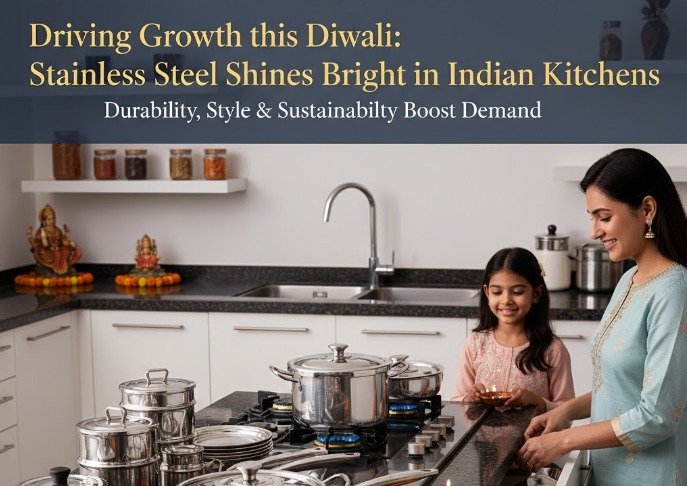
Stainless steel gleams in every Indian household. For decades, it has been the material that defines the look and feel of Indian kitchens. The clinking of stainless steel plates and the containers packed with homemade achaar resonate with most of us. Stainless steel has served Indian families for generations and now has found a renewed place through the rise of modular kitchens and sleek sinks. These appliances are not just functional items, they are a part of daily life, integrated into family routines and celebrations.
When Indian homemakers buy a new stainless steel set during Diwali, they are continuing a ritual of renewal and trust that has existed for generations. This trust exists due to stainless steel’s safety, durability, sustainability, easy maintenance, and a touch of nostalgia. With rising incomes and a growing middle class, stainless steel remains a key product in India’s growing market. For businesses, this represents a strong and stable opportunity. The material’s role in blending tradition with modern lifestyles also gives companies a platform to innovate through design, grade refinement, and sustainability.
Market perspective
The cultural loyalty towards stainless steel translates directly into numbers. According to Mordor Intelligence, stainless steel held around 35.4 per cent of India’s cookware market by material in 2024, making it one of the most dominant segments. The market for stainless steel cookware was valued at US $857.9 million in 2024 and is projected by Grand View Research to reach US $1,367.6 million by 2030, growing at a compound annual rate of 8.1 per cent.
According to Mordor Intelligence, stainless steel captured 73.33 per cent of the India kitchen sink and related market share in 2024, highlighting its dominance in this segment. The stainless steel modular kitchen market is estimated to be valued at US $1.2 billion in 2024 and is expected to reach US $1.9 billion by 2033, growing at a CAGR of 5.5 per cent, as per Verified Market Reports.
The overall Indian cookware market is expected to expand from US $3,013.6 million in 2025 to US $4,831.4 million by 2032, according to Persistence Market Research, with stainless steel leading that growth. Meanwhile, TechSci Research estimates that the broader Indian stainless steel market will rise from US $8.01 billion in 2025 to US $12.9 billion by 2031, also at a healthy annual growth rate of around 8.1 per cent.
Social media platforms like Instagram (reels) are also getting more millennials and Gen Zs interested in cooking, indirectly leading to an increase in demand for cookware. Clearly, stainless steel’s dominance is not only emotional but also economic. Its affordability, long life, and health benefits continue to make it a preferred material for kitchens in India.
Industry opportunity
As Indian kitchens become sleeker and more modular, the demand for refined, premium-grade stainless steel is growing. Consumers in urban centres are moving towards tri-ply and five-ply cookware, which distribute heat more evenly and look stylish on open kitchen shelves.
Stainless steel is making a significant impact in modular kitchens, particularly in sinks and cabinets. Stainless steel sinks are favoured for their corrosion resistance, ease of maintenance, and compatibility with modern kitchen designs, while stainless steel cabinets are gaining popularity due to their durability and resistance to termites, rust, and moisture.
Manufacturers have responded with innovations such as induction-ready bases, ergonomic handles, and satin-polished finishes. Quality certifications have helped maintain consumer confidence in branded stainless steel cookware. Grand View Research’s report identifies ‘pots & pans’ as the largest revenue segment and ‘pressure cookers’ as the fastest growing within stainless cookware.
According to Reuters, companies such as Jindal Stainless are already benefiting from this domestic strength. The firm reported a rise in quarterly profit in 2025 due to strong local demand. This situation reflects how end-user confidence in stainless steel products directly supports the upstream supply chain, from steelmakers and sheet suppliers to utensil manufacturers.
There is also strong export potential. Indian stainless steel cookware and utensils are gaining traction in Southeast Asia, Africa, and the Middle East, where Indian designs and price competitiveness offer an edge. According to Volza export data, India shipped 2,283 stainless steel cookware export shipments until 13 August 2025. For suppliers, this opens a dual growth path, serving both a loyal domestic market and expanding international demand.
Brand and material connect
These are not just product claims but reflections of its symbolic value. For Indian homemakers, stainless steel represents strength and self-connection. The fact that ‘pressure cookers’ are the fastest-growing product segment suggests people want durable tools needed for daily, heavy cooking, not just aesthetic pieces.
Brands that build campaigns around these values have an opportunity to deepen loyalty. By positioning stainless steel as a sustainable and emotional material, not just a functional one, manufacturers can elevate it from a commodity to a lifestyle choice. The high expected CAGR of 8.1 per cent for stainless steel in India (2025-31) implies consumers are willing to pay for longer-lasting, better-quality products.
As sustainability becomes a global concern, stainless steel’s recyclability adds another layer of appeal. It aligns with eco-conscious trends while preserving the emotional promise of longevity. Every time a household chooses a stainless steel container, it replaces a plastic one, which is a small but meaningful step towards a greener planet.
Festive surge and market boost
Festivals like Diwali remain one of the biggest consumption periods for stainless steel. Culturally, it is a time for cleansing, renewal, and new beginnings. Families invest in new items and upgrades as symbols of prosperity. Businesses often report a surge in stainless steel sales during this season. For manufacturers, this festive sentiment offers a powerful marketing window. Manufacturers and suppliers who invest in design, grade refinement, and sustainability will stay ahead.
Government initiatives like “Make in India” and the growth of local manufacturing have made stainless steel products more affordable and widely available. As people’s incomes rise and more Indians aspire to own durable, high-quality household items, demand for stainless steel goods is growing fast. With the country’s middle class expected to reach about 547 million by 2025, this expanding consumer base is set to further boost India’s stainless steel market.