University of Hong Kong researchers’ revolutionary work on SS green hydrogen production
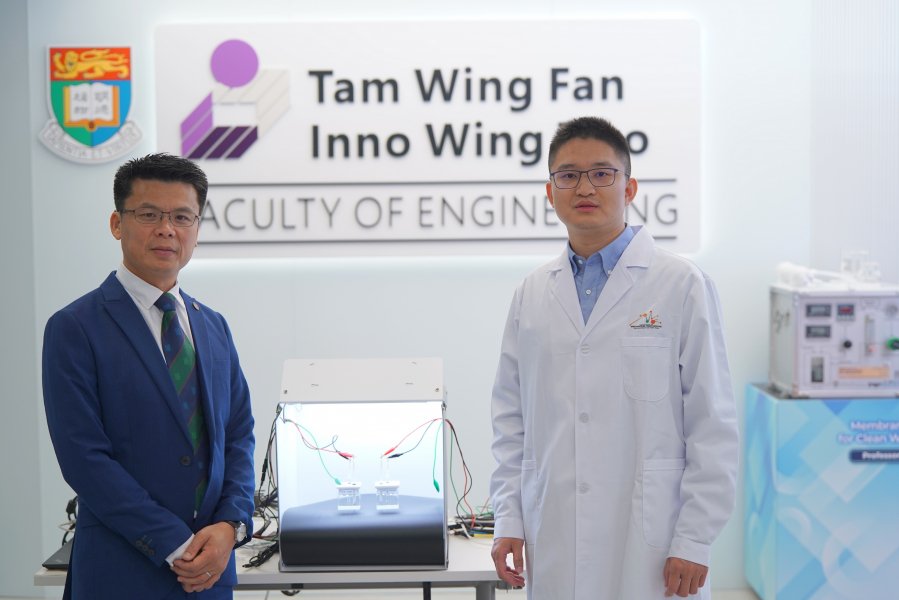
Professor Mingxin Huang and Dr Kaiping Yu
A pioneering research project led by Professor Mingxin Huang from the Department of Mechanical Engineering at the University of Hong Kong (HKU) has achieved a major breakthrough in stainless steel technology.
This latest innovation, from the Department of Mechanical Engineering at the University of Hong Kong (HKU), is dubbed stainless steel for hydrogen (SS-H2). It presents a cost-effective and highly corrosion-resistant material poised to transform green hydrogen production, particularly from seawater, as per a paper published last year on the University’s website.
This achievement marks another milestone in Professor Huang’s illustrious ‘Super Steel’ Project, following the creation of anti-COVID-19 stainless steel in 2021 and ultra-strong, ultra-tough Super Steel innovations in 2017 and 2020.
Advancing SS for hydrogen production
The newly developed SS-H2 showcases superior corrosion resistance, making it a potential game-changer for hydrogen production through seawater electrolysis. Its performance in saltwater electrolysers rivals that of titanium—currently the industry standard—but at a fraction of the cost, signalling significant economic benefits.
The findings, published in Materials Today, under the title “A sequential dual-passivation strategy for designing stainless steel used above water oxidation,” are supported by patent applications in multiple countries, two of which have already been authorised.
Science behind SS-H2: A dual-passivation breakthrough
Since its inception over a century ago, stainless steel has relied on chromium (Cr) to provide corrosion resistance through a passive film of Cr2O3. However, conventional stainless steel faces a limitation: transpassive corrosion occurs at approximately 1000 mV (SCE), below the 1600 mV potential needed for water oxidation.
High-performance stainless steels like 254SMO, while effective in seawater, suffer from transpassive corrosion, limiting their application at higher potentials. To overcome this, Professor Huang’s team devised a ‘sequential dual-passivation’ strategy.
This innovative approach introduces a secondary manganese (Mn)-based passive layer over the chromium-based layer at ~720 mV. The dual-passivation mechanism allows SS-H2 to withstand corrosion in chloride environments up to an ultra-high potential of 1700 mV—far surpassing traditional materials.
A Counterintuitive Discovery
Dr Kaiping Yu, the study’s lead author and a PhD student under Professor Huang, highlighted the unexpected nature of the findings: “Initially, we did not believe it because the prevailing view is that Mn impairs corrosion resistance. However, atomic-level analysis convinced us of this counterintuitive yet groundbreaking mechanism.”
This discovery required nearly six years of meticulous research, from conceptual development to experimental validation, culminating in a paradigm shift for high-potential-resistant alloys.
Cost-saving potential for industrial applications
Current water electrolysis systems for hydrogen production rely on costly materials such as gold- or platinum-coated titanium. For example, a 10-megawatt PEM electrolyser system costs around HK$17.8 million, with structural components accounting for over half of the total expense.
The introduction of SS-H2 could reduce the cost of structural materials by up to 40 times, offering a significant reduction in hydrogen production costs. Collaborations with mainland factories have already enabled the production of SS-H2-based wire, paving the way for industrial applications.
A promising future
While challenges remain in transitioning SS-H2 from experimental materials to industrial products like meshes and foams, the team is optimistic. Professor Huang stated, “We’ve made significant progress toward industrialisation. SS-H2 represents a leap forward in using more economical materials for hydrogen production from renewable sources.”
This breakthrough establishes a new paradigm for alloy development and holds immense potential for advancing sustainable energy technologies.